
Our school attendance champion is: Mr Andy Wright
Shillingstone CE Primary School Attendance Policy – Attendance Policy 2025
Our attendance leaflet summarises the key points for parents:
Shillingstone Attendance Leaflet – pg 1 Shillingstone Attendance Leaflet – pg 2
We strive for all our children to feel safe, loved, inspired and ready for the next step of their education. To achieve this, we aim to ensure that all children attend school regularly and on time. This enables our children to take full advantage of the educational opportunities we offer. Regular, punctual attendance is valued and positively encouraged for all pupils.
It’s recognised that some pupils, for a variety of reasons, find it harder than others to attend school regularly. Our policy sets out how we will work in partnership with pupils, parents and other professional agencies to remove barriers and support regular attendance.
The School Day and Punctuality
School starts at 08:30am. School finishes at 3:15pm.
Children that arrive after 08:45 but before 9am will be marked as late.
Registration closes at 9am. Children arriving after this time must attend the school office, be signed in and provide a reason for the lateness.
In the absence of a satisfactory reason, the register will be marked as an unauthorised late absence. Note: legal action can be taken for continued unauthorised absences.
Expected Levels of Attendance
Attending school regularly and on time has a positive impact on learning, progress and therefore the best life chances for pupils. Research shows that attendance and punctuality are important factors in school success.
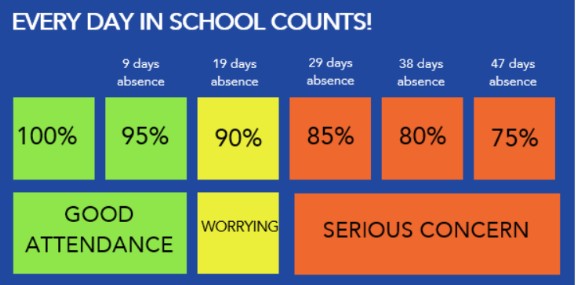
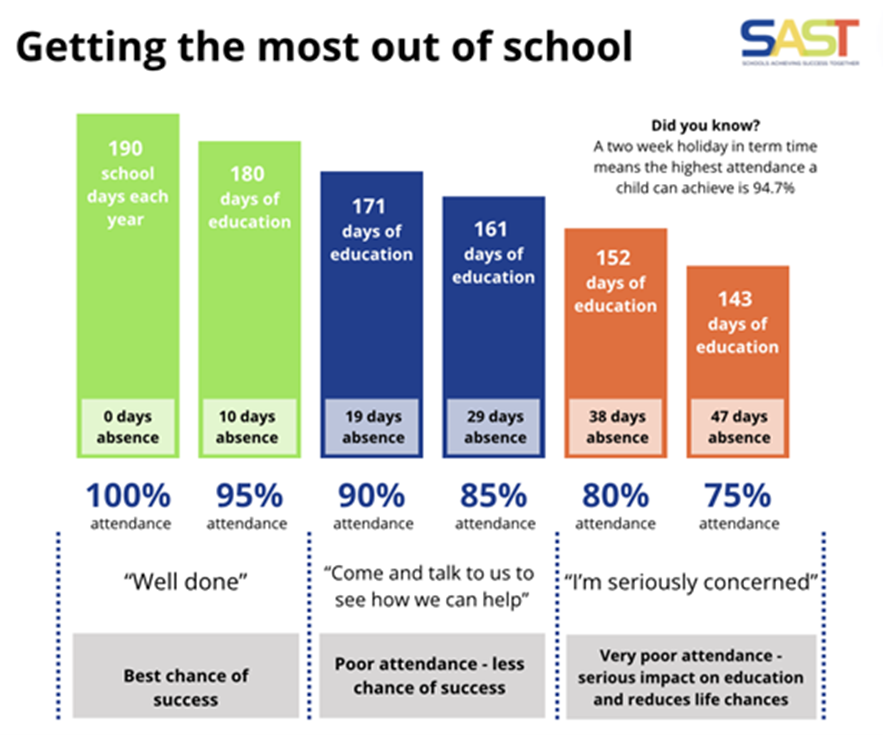
Below is a graph showing how being late to school every-day over a school year adds up to lost learning time.

Attendance is Key to Success
Learning at our school is inclusive, interactive and sequential. The knowledge we expect children to retain is cumulative – knowledge and skills built over time. Children who aren’t attending school regularly develop gaps in their learning. Being absent or persistently late also disrupts learning for the rest of the class whilst these children are reintegrated.
We are committed to
· an inclusive and welcoming learning environment.
· an orderly learning environment where children feel safe.
· building positive relationships with parents, other agencies and wider community.
· an open-door policy where staff are approachable and understand the barriers to attendance.
· training our staff to recognise emotionally based school avoidance (EBSA).
· monitoring attendance and recognising when intervention is required.
· closing the gap in attendance for our most vulnerable pupils.
· Team Around the Family/Early Help meetings to support families where necessary.
· having high expectations for all our school community.
· high quality teaching and learning.
· providing a broad and balanced curriculum, with a range of resources to support and challenge learning.
· encourage our pupils to flourish (as individuals) through providing spiritual, moral and cultural understanding and opportunities.
· inspiring our pupils by sharing celebrations from inside and outside of school.
We expect the following from parents and carers:
• To ensure their children attend school regularly and punctually
• To notify the school of your child’s absence- on each morning of absence and provide specific reason for the absence.
• To ensure that their children arrive in school well prepared for the school day
• To talk to a member of school staff about any problem or reason that may prevent them from attending school
• Inform the School of up-to-date contact numbers and details.
Schools are required to hold more than one emergency contact per child (KCSIE 2024). Emergency contact numbers should be provided and updated by the parent with whom the pupil normally resides.
· To notify the school of your child’s absence- on each morning of absence and provide a specific reason for the absence.
· To ensure that their children arrive in school well prepared for the school day
• To talk to a member of school staff about any problem or reason that may prevent them from attending school
Parents and pupils can expect the following from school:
•Early contact with parents when a pupil fails to attend school without providing good reason;
•Regular, efficient and accurate recording of attendance
•To inform parents if a pupil’s attendance falls below expected levels
•To listen and understand the barriers to school attendance and offer appropriate support and agree appropriate plans to improve attendance.
•Follow up support if needed.
•When a child is absent and the school cannot contact parents, those leading schools/responsible for attendance matters or safeguarding, will continue to try and make contact. Where necessary (and by the third day of absence at the latest), they will make a welfare visit to the home address to confirm the safety of the child. A record of attempts and contact will be made on the school’s system.
It is the requirement of school to inform the Local Authority when a child has 15 days absence due to illness, cumulative or consecutive – or when it is believed they will be unable to attend (The “section 19” duty).
In this section
