
Intent
We believe a high-quality computing education equips all children with the skills and knowledge in computational thinking and creativity to help them to understand the  world that they live in and be able to be ambitious, successful young people. Computing is a significant part of everyone’s lives and we believe that children should be at the forefront of new technology to complement and enhance their learning and experiences in a broad and balanced way.
Computing has strong links to a variety of other subjects such as mathematics, science, design and technology and therefore we believe that it is also integrated into other areas of learning, using a range of hardware, software and opportunities. We recognise that pupils are entitled to a structured and progressive approach to the learning of new knowledge and skills, needed to respond to new developments in technology, and we aim to equip pupils with the confidence and capability to use a range of different devices to enhance their experiences. We strive to provide a relevant, progressive and enjoyable curriculum for all pupils, as well as using it for a tool to enhance learning throughout the wider curriculum.
Implementation
Computing at Shillingstone Primary is informed by, but not limited to the ‘Teach Computing’ curriculum that uses the National Centre for Computing Education’s computing taxonomy to ensure comprehensive coverage of the subject and the national curriculum for computing, which aims to ensure that all pupils:
· can understand and apply the fundamental principles and concepts of computer science, including abstraction, logic, algorithms and data representation.
· can analyse problems in computational terms, and have repeated practical experience of writing computer programs in order to solve such problems.
· can evaluate and apply information technology, including new or unfamiliar technologies, analytically to solve problems.
· are responsible, competent, confident and creative users of information and communication technology.
There are four key elements to the computing curriculum, online safety, computational thinking, digital literacy and information technology. Pupils are provided with an ambitious education in computing, equipping them with knowledge and skills to understand and challenge our changing world.
E-safety – It is crucial to build children’s resilience to potential online threats through understanding risky behaviours and knowing how and where to seek help when things go wrong. It is now more important than ever that pupils understand how to use technology positively, responsibly and safely, and that they see good models of this. E-safety is referred to in every computing unit, in addition to discrete units taught at some point throughout the year. Our PSHE curriculum (Jigsaw) also contributes to our delivery of e-safety. Pupils also take part annually in ‘Internet Safety Day’, following the suggested theme, which reflects current issues.
Computer Science – Pupils are taught the principles of information and computation,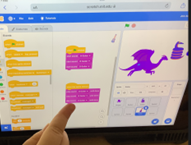 how digital systems work, and how to put this knowledge to use through programming. Pupils work analytically and systematically at challenges, creating algorithms for each small step and a sequence of coding to build more complex procedures.
Digital Literacy – As our lives are increasingly influenced by devices, pupils are taught to use, access and express themselves through digital technology. Pupils learn to understand how computers and computer systems (such as the internet) work, and how they are designed and programmed. Pupils develop a critical understanding of technology’s impact on the individual and society, at a level suitable for the future and as active participants in a digital world.
Information Technology – Pupils are equipped to evaluate and create content in imaginative and purposeful ways. They use information technology, such as laptops and other digital devices to collect, analyse, evaluate, save and retrieve data, research information on the internet, support the presentation of information and engage with learning in other subjects.
Pupils work towards the key knowledge and skills informed by the National Curriculum and build towards identified key stage end points. At Shillingstone, a unit of sequenced ‘Teach Computing’ lessons is taught over a term. Whilst some of the digital literacy and information technology aspects of the computing curriculum are linked with our Cornerstones curriculum, computer science is taught as a discrete unit. The overview below maps out the units of work taught in each year group.
Knowledge and skills have been identified within each of the ‘Teach Computing’ units across mixed-age classes and systematic progression is mapped to meet those objectives.
Impact
At Shillingstone Primary School, there are many opportunities for learners to apply their evolving knowledge imaginatively, becoming fluent and creative in their mastery of computing.
Teachers will make a judgement on whether pupils have met, exceeded or are working towards the objectives set and progress is tracked. Evidence of progression and achievement will be seen in examples of pupils’ work stored on the server. As a result of effective implementation, pupils will be able to apply their skills and knowledge in other areas of learning and be prepared for the next stage in their lives, knowing how to be a responsible user of technology in the wider world and most importantly, know where to seek support.
The depth and breadth of coverage will provide all our pupils with a solid grounding for future learning and the ability to become active digital citizens in the modern world.
Pupil Voice
This is what the pupils think about Computing in our school…
“I love computing, I get to use different programmes to make new things!”
“I look forward to our next computing lesson.”
“We have be learning about physical computing and using a programme called Crumbles to programme different colours from the Sparkle.”
In this section
