
Science
Intent
Science has shaped and informed the world we live in today and will continue to do so; therefore it is a vital subject not just for the enjoyment and challenges it offers but also for its contribution to life and future economic prosperity. Children are born with a natural curiosity about the world around them and when they first begin to speak they frequently question things and ask “why?”
Within science pupils are encouraged to develop a sense of excitement and curiosity about natural phenomena. Alongside this, they will build up a body of key scientific knowledge and concepts, providing the foundations for understanding the world.
All children are taught essential aspects of the knowledge, methods, processes and uses of science. They are encouraged to understand how science can be used to explain what is occurring, predict how things will behave, and analyse causes.
Our main aims for science, taken from the National Curriculum, are to ensure that all pupils:
· develop scientific knowledge and conceptual understanding;
· develop understanding of the nature, processes and methods of science through different types of science enquiries that help them to answer scientific questions, some self-posed, about the world around them;
· are equipped with the scientific knowledge required to understand the uses and implications of science, today and for the future;
· develop positive attitudes towards learning and enjoy setting, seeking, enquiring, exploring and finding or offering possible ideas and solutions to the many questions that arise as we seek to understand ourselves and the world in which we live.
Implementation
Our Science curriculum is based on the Maestro Cornerstones 22 curriculum. These projects are all sequenced to develop children’s knowledge, and if possible, make meaningful links to other projects. For example, in Year 4, the project Misty Mountain, Winding River has a Geography link to the Water Cycle and a Science link to materials through the teaching of evaporation and condensation. These links allow for children to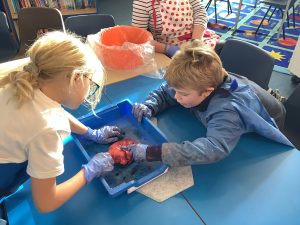 embed their Science knowledge in new and often real-life contexts.
The sequencing of projects ensures that children have the knowledge and vocabulary to comprehend subsequent projects fully. Each project’s place in the year has also been carefully considered. For example, projects that involve observing plants (Year 1 project Plant Parts) are positioned at a suitable time of year to give children the best possible opportunity to make first-hand observations.
Please read the curriculum overview to see where the Science projects are taught throughout the school.
Impact
Our project-led approach in this subject results in a fun, engaging and high-quality Science education which provides children with the foundations and knowledge for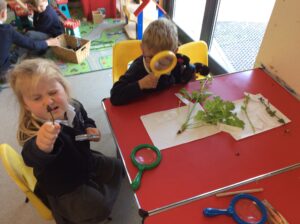 understanding the world. This is evident in pupils’ work (topic and floor books), photos, and displays.
Through well-sequenced lessons, children at Shillingstone CE Primary School have the understanding that science has changed our lives and that it is vital to the world’s future prosperity.
Science news and events
Circulatory System Science Project (Year 5 and 6 project)
This project will be something we will never forget! It was certainly a memorable learning experience. To help the children to learn about and understand the heart, we handled and closely analysed pig’s hearts in school. We were able to identify the main vessels but couldn’t believe how tough they were!
How do animals stay warm? Science Investigation (Year 5 and 6 project)
The children conducted 3 different experiments: one with 2 gloves; one with air trapped between the two gloves; and the third with a thick layer of lard smeared between the two gloves. The tester then put their hand in an ice-cold bowl of water and it was timed how long it took them to feel the coldness of the water. The children repeated their experiments 3 times to then calculate an average reading. It was really interesting!
Sound Project (Year 3 and 4 project)
This was a science based topic where the children learnt how sounds were created. They found out that sound travels in waves and that different volumes or pitches create different sound waves. They enjoyed using a sound meter to experiment with sound.
Pupil Voice
This is what the pupils think about Science in our school…
“I loved adding cells to my circuit to make the bulb shine brighter.”
“I have learnt that in Autumn the leaves get brown and start to fall off of the trees.”
In this section
