
Intent
At Shillingstone Primary School, our overall aim in Maths is to equip all of our pupils with the life skills they need to be able to flourish in the real world and promote a love for maths. We aim to ensure that, regardless of background and ability, every pupil has a rich and meaningful mathematical education. We recognise the great importance and power of talk for maths, from developing the vocabulary to articulate their understanding of concepts to diving deeper to make connections. We aim to develop our pupils’ mathematical oracy as a core skill as they progress through Shillingstone Primary.
We understand that Mathematics is a creative and highly inter-connected discipline that has been developed over centuries, providing the solution to some of history’s most intriguing problems. It is essential to everyday life, critical to science, technology and engineering, and necessary for financial literacy. Crucially, a sound knowledge of mathematics is vital for young people seeking employment, and securing a qualification in mathematics is a fundamental requirement for the majority of employers. A high-quality mathematics education therefore provides a foundation for understanding the world, the ability to reason mathematically, an appreciation of the beauty and power of mathematics, and a sense of enjoyment and curiosity about the subject.
Therefore, our high-quality mathematics curriculum provides a foundation for understanding the world, the ability to reason mathematically, an appreciation of the beauty and power of mathematics, and a sense of enjoyment and curiosity about the subject.
In line with the National Curriculum Objectives for Mathematics, our intent is that all pupils:
* become fluent in the fundamentals of mathematics, including through varied and frequent practice with increasingly complex problems over time, so that pupils develop conceptual understanding and the ability to recall and apply knowledge rapidly and accurately
* reason mathematically by following a line of enquiry, conjecturing relationships and generalisations, and developing an argument, justification or proof using mathematical language * can solve problems by applying their mathematics to a variety of routine and non-routine problems with increasing sophistication, including breaking down problems into a series of simpler steps and persevering in seeking solutions Mathematics is an interconnected subject in which pupils need to be able to move fluently between representations of mathematical ideas.
Mathematics is an interconnected subject in which pupils need to be able to move fluently between representations of mathematical ideas. The programmes of study are, by necessity, organised into apparently distinct domains, but pupils should make rich connections across mathematical ideas to develop fluency, mathematical reasoning and competence in solving increasingly sophisticated problems. They should also apply their mathematical knowledge to science and other subjects.
Implementation
 Our Maths curriculum is based on White Rose Maths which is a whole-school mastery programme designed to spark curiosity and excitement and to help pupils develop confidence in maths. Mathematics is taught as a discrete subject. Where possible and relevant, links are made with other areas of the curriculum.
White Rose (new schemes – version 3.0) provide a long term overview of progression to ensure coverage of all areas of the National Curriculum. Maths is taught daily through a small step sequence to ensure a good level of coherence, understanding, application of understanding and transference of skills to a range of mathematical problems and contexts. These units of work are progressive within each year group and also from one year group to the next.
MATHS White Rose overviews 2025 26 – whole school
The units of work allow the teachers to tailor to the needs of the class, scaffolding and challenging where needed, whilst ensure the correct small steps are sequenced for their development. Teachers may decide to spend more time on a unit than others if they discover a gap in children’s understanding. Equally, teachers may decide to work through a block of work more quickly if children have a good grasp of the learning objective. There is also clear progression from one year group to the next, throughout the primary years.
In all lessons, children are posed with a variety of question types: varied fluency, reasoning and problem solving. Children who show a good understanding within a lesson of the objective being taught, are extended further by ‘Greater Depth’ questions. These maths questions support children to develop and then show they have a deeper understanding of the objective taught. Teachers may use a variety of resources for these Greater Depth questions (e.g. Classroom Secrets website, Master the Curriculum).
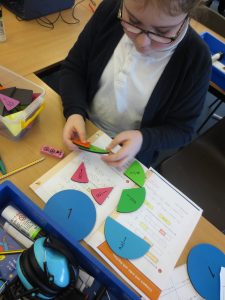
Children’s learning is supported and consolidated using practical resources throughout the school.
Online platforms

We use TTRS to enhance, consolidate and extend our maths learning for our children in and out of school.

Calculation policies
Click on the links below to see our Calculation policies:
Addition and subtraction calculation policy WHITE ROSE
Multiplication and Division calculation policy WHITE ROSE
Maths Teaching in Early Years Foundation Stage (EYFS)
Our curriculum focuses on the children working towards achieving the Early Learning Goals (ELGs). We use Development Matters as a reference. Teachers follow White Rose maths which aligns with the new statutory framework for EYFS 2021. The teachers deliver a curriculum that embeds mathematical thinking and talk. It provides a variety of opportunities to develop the understanding of number, shape, measure and spatial thinking. End of year assessments are made against Early Learning Goals.
Impact

Maths learning is seen as hugely important throughout the whole school. The children are engaged and enthusiastic in lessons.
This is what our pupils think about Maths in our school:
“I used to find maths tricky but this year, I have got so much better.”
“The adults help me if I get stuck.”
“Sometimes I choose to use things to help me work out the answer.”
“I love the games on Sumdog. It helps me to practise my maths in a fun way.”
Assessment is an integral and continuous part of the teaching and learning process at Shillingstone Primary. Teachers integrate the use of formative assessment strategies such as effective questioning, clear learning challenges, the use of learning ladders, effective feedback and response in their teaching and marking and observing children participating in activities. At the end of each mathematical unit, White Rose have a short assessment task which we use from Year 1 to Year 6. Teachers use this assessment to look for any gaps before moving onto the next unit or areas to focus on through reasoning tasks in future sessions.
In addition to the above, the impact of our maths provision is monitored in a variety of ways:
– Learning walks by the subject leader;
– Collaborative ‘book looks’ with teaching staff;
– Teacher judgements made on tracking sheets;
– Internal moderations;
– Insight assessments recorded;
– Year 4 statutory multiplication check; and
– End of Key Stage 1 & 2 statutory testing.
In this section
